For a long time, I struggled to find the right way to teach Science, Social Studies, and Health in my busy Grade 1 classroom.
Like many primary teachers, I often felt pulled toward literacy and numeracy. There was only so much time in the day, and these other subjects could be difficult to plan.
I wanted my students to learn the Saskatchewan curriculum outcomes, but I didn’t want their learning to become a stack of worksheets.
So I made a change.
I stopped using worksheets as the main way I taught Science, Social Studies, and Health.
Instead, I began using discussion, questions, hands-on activities, books, and real experiences to help my students build understanding.
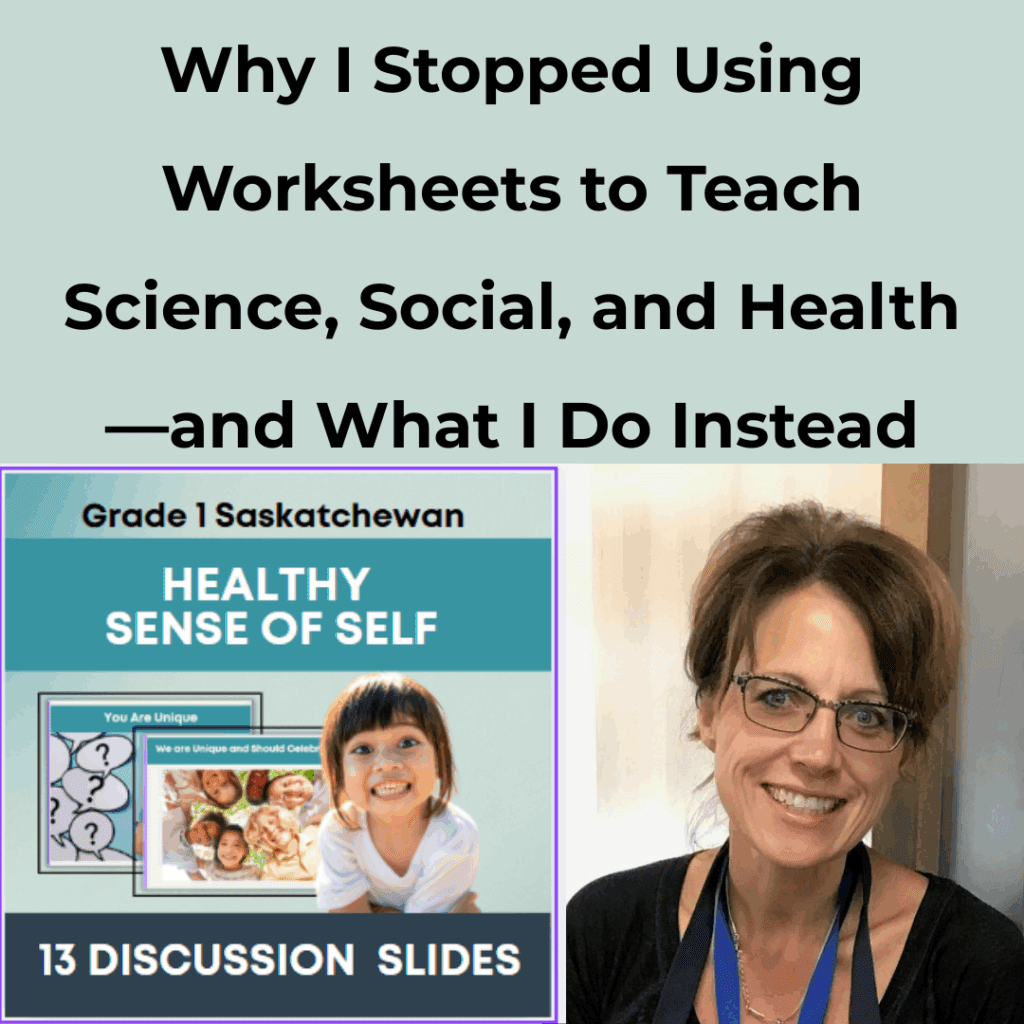
One of the tools that made this much easier for me was something I created called Discussion Slides.
Why I Moved Away From Worksheets
I have nothing against worksheets.
There are times when a worksheet can be useful. It can provide practice, help students record their thinking, or give a teacher information about what a child understands.
The problem comes when a worksheet becomes the main way children learn.
In my Grade 1 classroom, I often found that worksheets created several challenges.
I spent hours:
- Searching for resources
- Putting lessons together from different sources
- Adapting activities to match the Saskatchewan curriculum
- Changing worksheets so they were appropriate for my students
- Finding ways to support students who could not yet read or write independently
And sometimes, after all that work, I still wasn’t happy with the learning experience.
The worksheets might cover the outcome, but were my students actually thinking about the ideas?
- Were they asking questions?
- Were they making connections?
- Were they explaining what they understood?
I wanted more.
Young Children Don’t Need to Read a Worksheet to Learn
This was one of the biggest changes in my thinking.
My Grade 1 students were still developing their reading and writing skills.
If I gave them a worksheet with several written questions, I couldn’t always tell whether a child was struggling with the science concept or struggling to read the directions.
Those are two very different things.
For example, imagine we are learning about animals and their needs.
I might ask:
What does an animal need to survive?
A child might have a wonderful answer.
They might know that animals need food, water, shelter, and space.
But if the question is written on a worksheet and the child is still a beginning reader, they may not be able to access the question independently.
Their reading skills should not prevent them from showing what they know about science.
This is one reason I began using more oral language and discussion during Science, Social Studies, and Health.
What I Use Instead of Worksheets
Instead of starting with a worksheet, I often start with a question.
For example:
What do you think plants need to grow?
Then we talk.
Students share what they already know.
- They listen to their classmates.
- They ask questions.
- They make connections to things they have seen at home or outside.
We might read a book, examine a real object, watch a short video, go outside, build something, draw a picture, or complete a hands-on activity.
The learning becomes active.
And most importantly, students have an opportunity to think.
Discussion-Based Learning Builds Understanding
One of my favourite ways to teach young children is through purposeful discussion.
When children talk about what they are learning, they have opportunities to:
- Explain their thinking
- Ask questions
- Make connections
- Listen to different ideas
- Use new vocabulary
- Build background knowledge
- Develop oral language
- Learn from their classmates
For young children, talking is an important part of learning.
A child may not be able to write a complete sentence about a science concept yet, but they may be able to explain the idea beautifully when we talk about it together.
That conversation gives me valuable information about what the child understands.
Discussion Slides Became One of My Favourite Tools
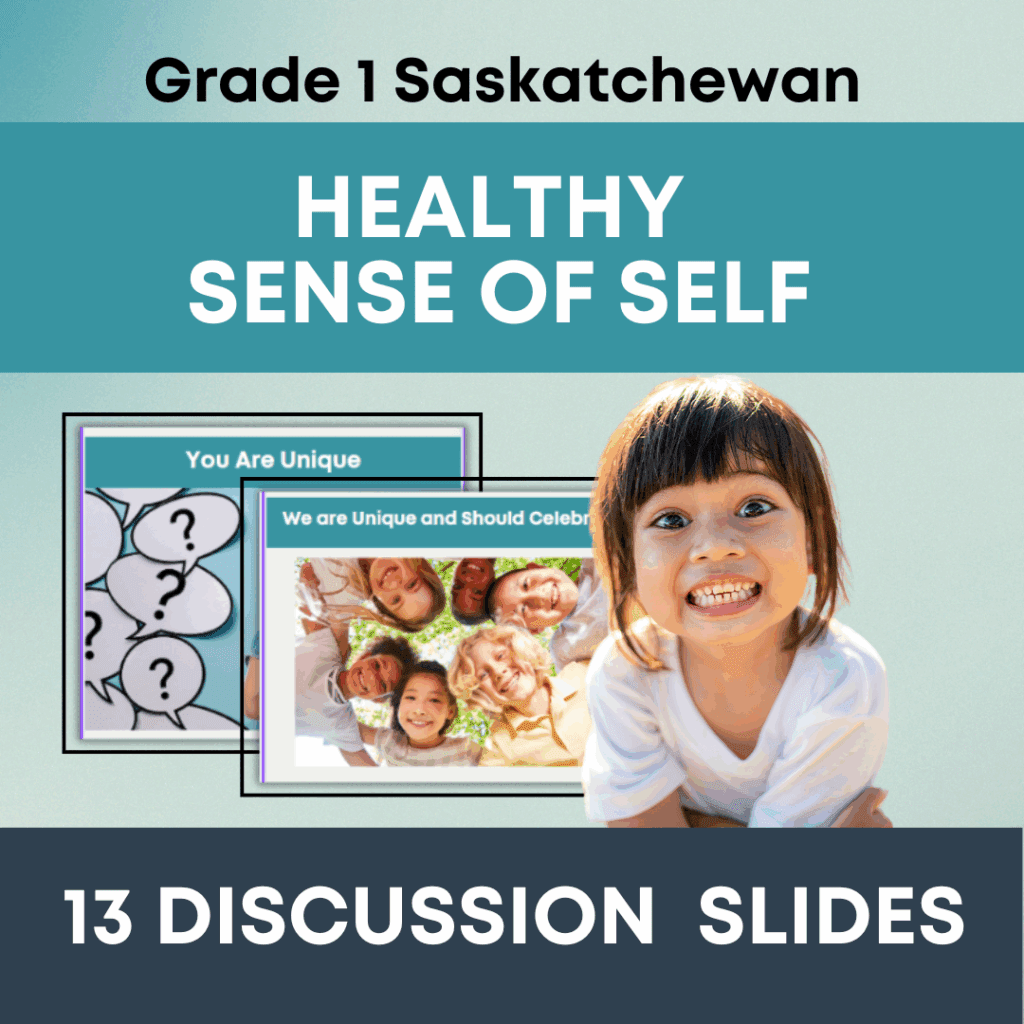
After years of experimenting with different ways to teach these subjects, I created Discussion Slides for my own classroom.
The slides became a simple way to organize a lesson around important questions and ideas.
I designed them specifically for Saskatchewan Grade 1 and Grade 2 curriculum outcomes.
Instead of asking students to complete a worksheet independently, I could display a question or image and invite students to think and talk.
For example, I might show a picture and ask:
What do you notice?
Then:
What do you wonder?
And finally:
What do you think is happening?
These simple questions can lead to surprisingly rich conversations.
Discussion Slides Support Different Learners
One of the things I love about discussion-based learning is that it gives more children a way to participate.
A student who is a strong reader may be able to read and respond to written questions independently.
A beginning reader may not be able to do that yet.
But both students can look at an image, listen to a question, think about their experiences, and share an idea.
This makes learning more accessible.
It also gives teachers the opportunity to hear the thinking of students who may not always demonstrate their knowledge through writing.
Add Hands-On Learning Whenever You Can
Discussion doesn’t mean children need to sit still and talk for an entire lesson.
In fact, I often combine discussion with hands-on learning.
For example, students might:
- Explore natural objects
- Sort materials
- Build a model
- Draw what they observe
- Conduct a simple experiment
- Act something out
- Use loose parts to represent an idea
- Read a related picture book
- Go outside to make observations
The discussion gives the activity purpose.
The hands-on experience gives children something real to think about and talk about.
Together, they create a richer learning experience.
What About the Curriculum?
This is an important question.
Moving away from worksheets does not mean moving away from the curriculum.
In fact, starting with the curriculum outcome can help us choose better learning experiences.
I begin by asking:
What do I want my students to understand?
Then I ask:
What experiences will help them develop that understanding?
The answer might be a discussion.
- It might be a book.
- It might ben an experiement
- It might be a hands-on activcity
- It might be a walk outside
Or it might include a worksheet.
The worksheet is simply one possible tool, rather than the lesson itself.
You Don’t Have to Stop Using Worksheets
If you are a teacher who still uses worksheets, please don’t feel that I’m suggesting you need to throw them all away!
I still believe worksheets have a place in the classroom.
The important question is:
What is the purpose of this worksheet?
- Is it helping students practise something they already understand?
- Is it giving them a way to record their thinking?
- Is it helping you assess their learning?
Or are students completing it because you aren’t sure what else to do?
That last question is worth thinking about.
Start Small
If you want to use fewer worksheets, you don’t need to completely change your teaching overnight.
Try starting with one lesson.
Choose a Science, Social Studies, or Health outcome and ask:
What could my students do instead of completing a worksheet?
- Could they talk?
- Could they explore?
- Could they build?
- Could they sort?
- Could they observe?
- Could they draw?
- Could they investigate?
- Could they explain their thinking to a partner?
You might be surprised by how much learning can happen when you give children the opportunity to explore an idea together.
A More Meaningful Way to Teach
When I stopped making worksheets the centre of my Science, Social Studies, and Health lessons, I found that my students became more engaged.
- They talked more.
- They asked more questions.
- They made more connections.
And I learned more about what they understood.
Teaching young children doesn’t have to mean keeping them busy with paper.
We can give them opportunities to talk, wonder, explore, question, create, and make meaning.
And we can still meet the curriculum outcomes along the way.
That is what I love about discussion-based and hands-on learning.
It puts the learning back at the centre of the lesson.
Happy Learning,
Lynda
Want to Try Discussion Slides?
I created my Grade 1 and Grade 2 Discussion Slides to make teaching Science, Social Studies, and Health easier for primary teachers.
They are designed around the Saskatchewan curriculum and give you ready-to-use questions and prompts for meaningful classroom discussions.
➡️ Ready to try them out? Check out my growing collection of Grade 1 and Grade 2 Discussion Slides designed just for Saskatchewan teachers.
Click here to grab a free Grade 1 Healthy Sense of Self Discussion Slides file.
Happy Learning
Lynda